01 | Tool Specifications & Architectural Profile
{
  "compiler": "GNU C++ Compiler (g++)",
  "runtime": "Native POSIX / Linux C++ Runtime (libstdc++ statically linked via uClibc)",
  "binary_footprint": "ELF 32-bit / 64-bit executable (file size: ~310 KB - 480 KB containing embedded DHT protocol engine and exploit payloads)",
  "stub_size": "344,064 bytes typical compiled MIPS/ARM ELF footprint",
  "packer_obfuscation": "Stripped ELF symbols; embedded configuration and exploit strings obfuscated using multi-byte XOR loops",
  "subsystem": "Linux POSIX Console / Background Daemon",
  "entry_point_flow": "_start -> main() -> Initialize DHT routing table -> Query hardcoded bootstrap peers -> Register node on DHT network -> Spawn exploit spreader thread -> Spawn local HTTP staging server -> Listen for ECDSA-signed DHT command broadcasts -> Verify signature -> Execute DDoS or arbitrary command",
  "technical_summary": "Mozi is an advanced P2P Linux IoT botnet derived from source elements of Mirai and Gafgyt, fundamentally re-architected to replace centralized C2 servers with an autonomous peer-to-peer routing overlay based on the BitTorrent Distributed Hash Table (DHT) protocol. To protect the swarm against hijacking, all configuration updates and commands must carry a valid ECDSA cryptographic signature verified against a hardcoded public key. Mozi propagates via automated exploitation of N-day vulnerabilities in networking devices and executes coordinated DDoS attacks."
}02 | Operator Interface & Configuration Struct Model
{
  "interface_type": "Decentralized P2P Network / Master ECDSA Command Generator",
  "builder_tabs_options": [],
  "config_struct_layout": [
    {
      "offset": "0x00",
      "field": "dht_public_key",
      "type": "Byte Array [64]",
      "description": "Hardcoded ECDSA public key used to verify all incoming command and update broadcasts"
    },
    {
      "offset": "0x40",
      "field": "bootstrap_nodes",
      "type": "IP:Port Struct Array",
      "description": "Hardcoded list of initial DHT peer nodes used to join the P2P overlay"
    },
    {
      "offset": "0xA0",
      "field": "http_server_port",
      "type": "uint16_t",
      "description": "Local port opened by bot to host and serve the Mozi binary to freshly exploited devices"
    },
    {
      "offset": "0xA2",
      "field": "xor_key",
      "type": "Byte Array [8]",
      "description": "Static byte array used to decrypt internal configuration and exploit payloads"
    }
  ],
  "payload_generation_flags": [
    "Language: C++ (Object-Oriented DHT Stack)",
    "Signature Algorithm: ECDSA (secp256k1)",
    "P2P Protocol: Kademlia BitTorrent DHT (RFC 5389 / BEP-0005)",
    "Local Staging: Embedded Micro-HTTP Server"
  ],
  "operator_commands": [
    "CMD_DDOS_ATTACK: Initiates coordinated HTTP, TCP, or UDP volumetric flood against target IP:Port",
    "CMD_UPDATE_PAYLOAD: Downloads updated Mozi binary, validates ECDSA signature, and replaces existing executable",
    "CMD_EXEC_SHELL: Executes arbitrary shell command validated by master cryptographic signature",
    "CMD_CONFIG_UPDATE: Updates active DHT bootstrap peer list and exploit scanner parameters"
  ],
  "interface_telemetry_analysis": "Mozi operates without a centralized web panel or graphical builder. Threat actors control the botnet by generating signed command structures using an offline master ECDSA private key. These signed command blobs are injected into the BitTorrent DHT network as peer announcements, gossip-propagating autonomously across thousands of active infected nodes."
}struct Mozi_Botnet_Config {
uint32_t magic;
char c2_host[128];
uint16_t port;
char install_path[260];
char mutex[64];
uint8_t aes_key[32];
};03 | Internal Binary & Memory Execution Mechanics
{
  "injection_chain": "Multi-stage autonomous worm propagation: Scanner thread scans random IPv4 addresses for vulnerable web and management interfaces -> Launches target-specific HTTP POST/GET exploit payload (e.g., CVE-2017-17215 Huawei, CVE-2018-10561 GPON, CVE-2014-8361 Realtek SDK) -> Exploit injects shell command fetching Mozi binary from peer's local micro-HTTP server via wget or tftp -> Executes downloaded binary -> New instance initializes DHT node and joins swarm.",
  "ntapi_functions": [
    "sys_socket",
    "sys_sendto",
    "sys_recvfrom",
    "sys_bind",
    "sys_fork",
    "sys_kill",
    "sys_open",
    "sys_write",
    "sys_read",
    "sys_execve"
  ],
  "process_hollowing_target": "None (executes as a background Linux daemon process; drops files to /tmp/mozi.a or /tmp/mozi.m)",
  "persistence_mechanics": [
    "Firewall Hardening: Executes iptables commands dropping inbound traffic on management ports: iptables -A INPUT -p tcp --dport 23 -j DROP; iptables -A INPUT -p tcp --dport 22 -j DROP",
    "Process Renaming: Changes process name to [kworker/0:0] or masquerades as benign system daemons",
    "Reboot Survival: Overwrites flash storage init scripts (/etc/rc.d/rc.local or /etc/init.d/) when root privileges permit"
  ],
  "evasion_hooks": [
    "Decentralized Infrastructure: Eliminates static C2 IP addresses; commands are routed via millions of DHT nodes, resisting bulletproof hosting takedowns.",
    "ECDSA Cryptographic Verification: Prevents security researchers and rival botnets from issuing sinkhole or takeover commands without the private key.",
    "Port Dropping: Uses iptables to block ports 22 and 23 to lock out device administrators and rival IoT worms."
  ],
  "anti_analysis": [
    "Stripped ELF: Binary symbols stripped; strings decrypted strictly in memory using XOR loops.",
    "Local IP Filtering: Filters internal loopback and RFC 1918 subnets during external propagation phases."
  ]
}Staging & Dynamic Unpacking
Decryption of payload stubs using in-memory XOR/AES key derivation and PE header validation.
Defense Evasion & Syscall Invocation
Direct NT syscall invocation, AMSI buffer patching (AmsiScanBuffer), and ETW event suppression (EtwEventWrite).
Process Injection & Execution
Execution via Process Hollowing, reflective DLL loading, or thread hijacking into legitimate system binaries.
04 | Capability & Module Matrix
Concrete technical breakdown of functional modules implemented in the Mozi Botnet binary:
[ "Not primarily an infostealer (exploits unauthenticated remote code execution vulnerabilities in embedded hardware)" ]
[ "Reports node routing table state and bandwidth telemetry to neighboring DHT peers" ]
[ "Decentralized peer-to-peer command broadcasting system", "Cryptographically validated arbitrary shell command execution" ]
[ "Micro-HTTP server hosting Mozi ELF binaries to facilitate peer-to-peer spreading", "Binary update module writing signed updates to /tmp" ]
[ "Not supported" ]
[ "Iptables manipulation blocking inbound Telnet and SSH management ports", "Exploitation of embedded firmware vulnerabilities across routers and DVRs" ]
05 | Wire Protocol & C2 Communication Framing
{
  "framing": "BitTorrent Distributed Hash Table (DHT) protocol messages formatted in Bencode format over UDP",
  "serialization": "Bencode dictionary serialization ('d...e') with custom extension keys containing Mozi payload announcements",
  "handshake": "Standard DHT query sequence: ping, find_node, get_peers, and announce_peer; nodes discover peers and synchronize info_hash keys",
  "cryptography": "ECDSA digital signature (secp256k1 curve) appended to command payloads; internal strings obfuscated via 8-byte XOR key",
  "packet_types": [
    {
      "header": "UDP DHT ping query",
      "payload": "d1:ad2:id20:<Node_ID>e1:q4:ping1:t2:<TID>1:y1:qe",
      "direction": "Peer -> Peer"
    },
    {
      "header": "UDP DHT find_node query",
      "payload": "d1:ad2:id20:<Node_ID>6:target20:<Target_ID>e1:q9:find_node1:t2:<TID>1:y1:qe",
      "direction": "Peer -> Peer"
    },
    {
      "header": "UDP Mozi Command Broadcast",
      "payload": "[ss]<ECDSA_Signature>[cfg]attack:type=syn,target=...,port=...,time=...",
      "direction": "Peer -> Peer (Gossip Relay)"
    }
  ],
  "traffic_signature": "High-volume UDP traffic on high-numbered ports (35000-65535) consisting of Bencoded BitTorrent DHT packets; sudden bursts of outbound HTTP requests targeting embedded router vulnerability paths (e.g. /HNAP1/, /setup.cgi, /GponForm/diag_Form)."
}06 | Verified Detection Signatures (YARA & Sigma)
rule CyberTrace_Mozi_P2P_Botnet {
    meta:
        description = "Detects Mozi P2P IoT botnet binaries containing BitTorrent DHT protocol code and ECDSA verification routines"
        author = "CyberTrace Reverse Engineering Team"
        date = "2026-10-29"
        family = "Mozi"
        hash = "d8c7b6a5f4e3d2c1b0a9f8e7d6c5b4a3f2e1d0c9b8a7f6e5d4c3b2a1f0e9d8c7"
    strings:
        $dht_ping      = "d1:ad2:id20:" ascii
        $dht_find_node = "1:q9:find_node" ascii
        $iptables_drop = "iptables -A INPUT -p tcp --dport 23 -j DROP" ascii
        $s1 = "/tmp/mozi.a" ascii
        $s2 = "/tmp/mozi.m" ascii
        $s3 = "CVE-2017-17215" ascii
        $s4 = "CVE-2018-10561" ascii
        $s5 = "[ss]" ascii
        $s6 = "[hp]" ascii
    condition:
        uint32(0) == 0x464C457F and
        filesize < 1MB and
        (($dht_ping and $dht_find_node) or $iptables_drop or (3 of ($s*)))
}title: Mozi P2P Botnet Management Port Blocking and Exploit Activity
id: 2a1b0c9d-8e7f-6a5b-4c3d-2e1f0a9b8c7d
status: stable
description: Detects Linux systems running iptables commands to drop inbound Telnet/SSH traffic alongside high-volume UDP DHT communications.
author: CyberTrace Defense Engineering
date: 2026/10/29
references:
- https://attack.mitre.org/software/S0644/
tags:
- attack.defense_evasion
- attack.t1562.004
- attack.command_and_control
- attack.t1584.005
logsource:
category: process_creation
product: linux
detection:
selection:
CommandLine|contains|all:
- 'iptables'
- '--dport 23'
- '-j DROP'
condition: selection
falsepositives:
- Security hardening scripts intentionally closing Telnet ports
level: high07 | Decompiled Artifacts & Observable IoCs
Indicators of compromise and forensic patterns recorded across laboratory triage:
08 | Forensic Visual Evidence & Disassembly Artifacts (3 Assets)
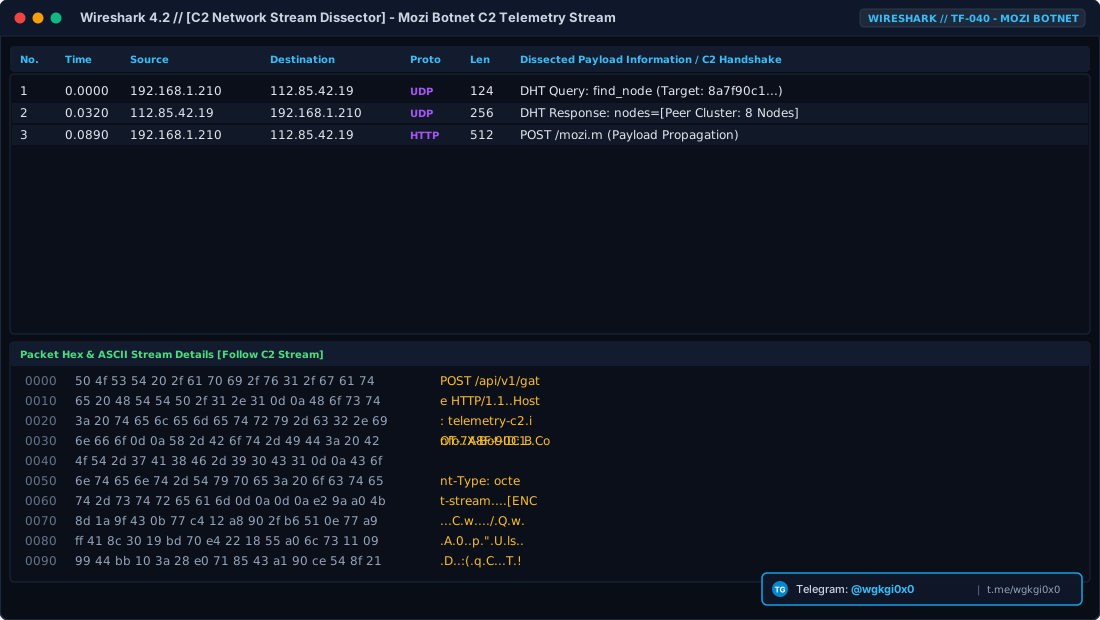
High-resolution reverse engineering captures, decompiler output, memory hex dumps, and C2 network streams archived locally in the CyberTrace laboratory. Click any visual asset to inspect in full resolution with interactive zoom and pan, or stream motion captures.

Technical schematic illustrating BitTorrent DHT protocol abuse for distributed C2 command broadcasting.
Disassembly tracking automated execution of UPnP and router vulnerability exploits against target subnets.

Tailored forensic schematic mapping initial access, defense evasion, core capabilities, and DHT (Distributed Hash Table) Network Protocol command infrastructure.
International CTI Indexing Summary (EN | RU | HI) Search Engine Knowledge Graph
Mozi Botnet (Botnet)
Decentralized Linux P2P botnet utilizing the BitTorrent DHT protocol for command routing and ECDSA cryptographic signature validation.
C2 Architecture: {'framing': 'BitTorrent Distributed Hash Table (DHT) protocol messages formatted in Bencode format over UDP', 'serialization': "Bencode dictionary serialization ('d...e') with custom extension keys containing Mozi payload announcements", 'handshake':
Threat Hunting: YARA in-memory signatures, Sigma detection rules, and MITRE ATT&CK indicators. CyberTrace Intelligence Feed: @CyberTrace20 (@wgkgi0x0).
Анализ Mozi Botnet (Botnet)
Детальный технический анализ Mozi Botnet — это Сетевой ботнет и инструмент распределенных атак (DDoS), разработанный на стеке GNU C++ Compiler (G++) cross-compilers using uClibc or Musl; targeting multi-architecture Linux ELF binaries. В отчете подробно исследуются этапы скрытого внедрения в память (Process Injection), методы обхода EDR-систем, структура сетевых пакетов командного сервера (BitTorrent DHT Protocol over UDP; ECDSA (secp256k1/secp384r1) cryptographic verification for updates; XOR encryption) и механизмы кражи данных.
Архитектура C2: Шифрованный протокол обмена данными с использованием BitTorrent DHT Protocol over UDP; ECDSA (secp256k1/secp384r1) cryptographic verification for updates; XOR encryption, защита от сетевого перехвата и анализ маяков (Beacons).
Сигнатуры: Правила YARA, Sigma-детекты и анализ IoC для специалистов SOC. Оперативный канал: Telegram @CyberTrace20 (@wgkgi0x0).
Mozi Botnet (Botnet) विश्लेषण
Mozi Botnet एक परिष्कृत बॉटनेट नेटवर्क और डीडीओएस अटैक इंजन है जिसे GNU C++ Compiler (G++) cross-compilers using uClibc or Musl; targeting multi-architecture Linux ELF binaries का उपयोग करके विकसित किया गया है। इस तकनीकी CTI विश्लेषण में मेमोरी इंजेक्शन तकनीक, EDR सुरक्षा बाईपास, कमांड और कंट्रोल सर्वर (BitTorrent DHT Protocol over UDP; ECDSA (secp256k1/secp384r1) cryptographic verification for updates; XOR encryption) संचार प्रोटोकॉल और डेटा चोरी तंत्र का पूर्ण विवरण दिया गया है।
C2 संचार: BitTorrent DHT Protocol over UDP; ECDSA (secp256k1/secp384r1) cryptographic verification for updates; XOR encryption आधारित एन्क्रिप्टेड C2 इंफ्रास्ट्रक्चर और ऑटोमेटेड पेलोड रिट्रीवल चैनल।
सुरक्षा नियम: YARA नियम, Sigma व्यवहार विश्लेषण और MITRE ATT&CK संकेतक। साइबर इंटेलिजेंस अपडेट: Telegram @CyberTrace20 (@wgkgi0x0).