01 | Tool Specifications & Architectural Profile
QuasarRAT is an open-source remote access trojan authored in C# (.NET Framework), widely weaponized across commodity cybercrime and advanced persistent threat operations. The implant establishes persistent, full-duplex TCP socket connections over TLS with pinned X.509 certificate validation. Its builder GUI allows operators to generate custom client executables equipped with startup persistence (Registry Run keys, Scheduled Tasks), process self-defense via RtlSetProcessIsCritical, low-level global keystroke logging (WH_KEYBOARD_LL), reverse SOCKS5 proxying, and interactive GDI+ desktop streaming.
02 | Operator Interface & Configuration Struct Model
Detailed reverse-engineering specifications archived in laboratory telemetry.
{
  "structureType": "Deserialized Static Class Model (Settings.cs)",
  "decryptionRoutine": "Settings class fields are stored as Base64 strings encrypted with AES-128-CBC. At runtime, the client decrypts each string using a key derived from the embedded password string via PBKDF2 (Rfc2898DeriveBytes) and an embedded static salt.",
  "inMemoryLayout": "public static class Settings {\n    public static string Version = \"1.4.1\";\n    public static string Hosts = \"192.168.1.100:4782;\";\n    public static string Password = \"EnCrYpTeD_PaSsWoRd\";\n    public static string InstallPath = @\"%APPDATA%\\SubDir\\client.exe\";\n    public static string Mutex = \"d0a927a4-8461-460b-80df-5418b76c02ef\";\n    public static string EncryptionKey = \"AESKeyBase64==\";\n    public static string AuthKey = \"HMACKeyBase64==\";\n    public static bool Install = true;\n    public static bool Startup = true;\n    public static bool HideFile = true;\n    public static bool Keylogger = true;\n}",
  "panelConfigOptions": "Quasar Builder GUI tabs: (1) Connection: Hostname/IP, Port (default 4782), Reconnect Delay; (2) Installation: Install Subdirectory (AppData, Local, ProgramFiles), Executable Name, Hide File; (3) Surveillance: Keylogger toggle, Webcam toggle; (4) Monitoring: Startup Run Key, Scheduled Task toggle, Mutex string, Set Process Critical (BSOD on kill); (5) Assembly: Icon changer, Assembly Metadata cloner; (6) Cryptography: TLS Certificate generator (.p12), Certificate Pinning SHA-256 fingerprint."
}03 | Internal Binary & Memory Execution Mechanics
{
  "mutualExclusion": "Instantiates a system Mutex (new Mutex(false, Settings.Mutex)) at process start. If the mutex already exists, the process calls Environment.Exit(0) immediately.",
  "processProtection": "Optionally invokes native NTAPI via P/Invoke ntdll.dll!RtlSetProcessIsCritical(1, NULL, 0). Marking the client process as critical forces the Windows kernel to trigger a BugCheck (BSOD 0xEF CRITICAL_PROCESS_DIED) if the process is terminated by Task Manager or security tools.",
  "persistenceMechanics": "Writes binary path to HKCU\\Software\\Microsoft\\Windows\\CurrentVersion\\Run or generates an elevated Scheduled Task via hidden process execution of schtasks.exe /create /tn \"<TaskName>\" /tr \"<Path>\" /sc onlogon /rl highest.",
  "surveillanceHooks": "Installs a low-level global keyboard hook (SetWindowsHookEx(WH_KEYBOARD_LL, ...)) to capture keystrokes, active window titles (GetForegroundWindow, GetWindowText), and clipboard contents (Clipboard.GetText), writing to an encrypted local buffer before transmission."
}Staging & Dynamic Unpacking
Decryption of payload stubs using in-memory XOR/AES key derivation and PE header validation.
Defense Evasion & Syscall Invocation
Direct NT syscall invocation, AMSI buffer patching (AmsiScanBuffer), and ETW event suppression (EtwEventWrite).
Process Injection & Execution
Execution via Process Hollowing, reflective DLL loading, or thread hijacking into legitimate system binaries.
04 | Capability & Module Matrix
Concrete technical breakdown of functional modules implemented in the Quasar Remote Administration Tool binary:
{'module': 'Remote Desktop Streaming', 'description': 'Captures desktop screen buffers using GDI+ Graphics.CopyFromScreen, encodes into JPEG byte streams with adjustable quality and frame rates.', 'apis': 'Graphics.CopyFromScreen, ImageCodecInfo, MemoryStream'}
{'module': 'Low-Level Keystroke Logger', 'description': 'Hooks global keyboard events to intercept user keystrokes across all windows with window title and timestamp context.', 'apis': 'SetWindowsHookEx (WH_KEYBOARD_LL), CallNextHookEx, GetForegroundWindow'}
{'module': 'Reverse SOCKS5 Proxy', 'description': 'Establishes a client-side multi-threaded SOCKS5 proxy server allowing the operator to route arbitrary network traffic through the victim endpoint.', 'apis': 'Socket, TcpClient, NetworkStream'}
{'module': 'Interactive Remote Shell', 'description': 'Spawns hidden cmd.exe process with redirected standard input and output streams piped directly across the TLS socket.', 'apis': 'ProcessStartInfo, Process.StandardInput, Process.StandardOutput'}
{'module': 'Browser & Application Password Harvester', 'description': 'Extracts stored credentials from Chromium and Gecko browsers, FileZilla, and WinSCP using DPAPI decryption.', 'apis': 'ProtectedData.Unprotect (DPAPI), SQLite parsing'}
05 | Wire Protocol & C2 Communication Framing
QuasarRAT utilizes raw TCP sockets encrypted with TLS via the .NET SslStream class. The client validates the server's certificate against a pinned SHA-256 public key hash configured during compilation. Message framing follows a 5-byte header convention: [ 4-byte Int32 Payload Length (Little-Endian) ] [ 1-byte Message Type Identifier ] [ Serialized Binary Payload ]. In standard Quasar builds, payloads are serialized using custom binary writers or Protocol Buffers/MsgPack in modified variants. Payload contents are symmetrically encrypted with AES-128-CBC using a key derived from the configuration password via PBKDF2.
06 | Verified Detection Signatures (YARA & Sigma)
rule CyberTrace_QuasarRAT_Client {
    meta:
        description = "Detects QuasarRAT .NET client binaries and characteristic settings metadata"
        author = "CyberTrace CTI Operations"
        date = "2026-10-29"
        hash = "3c98f86f789d31b017835160c5a3d0b28669e4f1a2656360c70e28e46123491e"
        category = "RAT"
    strings:
        $s1 = "Quasar.Client" ascii
        $s2 = "Settings" ascii
        $s3 = "RtlSetProcessIsCritical" ascii
        $s4 = "SetWindowsHookEx" ascii
        $guid = "d0a927a4-8461-460b-80df-5418b76c02ef" ascii
        $proto1 = "DoDownloadAndExecute" ascii
        $proto2 = "GetAuthentication" ascii
    condition:
        uint16(0) == 0x5A4D and
        ( 3 of ($s*) or $guid or ( 2 of ($proto*) and 1 of ($s*) ) )
}title: QuasarRAT Process Marking as Critical
id: 5a1b3c72-8d9e-40f1-a2b3-6c7d8e9f0a1b
status: stable
description: Detects suspicious invocations of RtlSetProcessIsCritical by non-system processes characteristic of QuasarRAT defense evasion.
author: CyberTrace Defensive Engineering
date: 2026-10-29
logsource:
category: process_tampering
product: windows
detection:
selection:
Type: 'SetProcessIsCritical'
filter:
Image|startswith:
- 'C:\Windows\System32\'
- 'C:\Windows\SysWOW64\'
condition: selection and not filter
fields:
- ProcessId
- Image
falsepositives:
- Legitimate endpoint security products (rare)
level: high
tags:
- attack.defense_evasion
- attack.t1562.00107 | Decompiled Artifacts & Observable IoCs
Indicators of compromise and forensic patterns recorded across laboratory triage:
Decompiled Disassembly & Reverse-Engineering Strings
// Decompiled QuasarRAT Client Settings Decryption & TLS Connection
public static void DecryptSettings() {
    byte[] authKey = Convert.FromBase64String(Settings.AuthKey);
    byte[] encKey = Convert.FromBase64String(Settings.EncryptionKey);
    Rfc2898DeriveBytes derive = new Rfc2898DeriveBytes(Settings.Password, authKey, 50000);
    byte[] aesKey = derive.GetBytes(16);
    byte[] aesIv = derive.GetBytes(16);
    Settings.Hosts = AES.Decrypt(Settings.Hosts, aesKey, aesIv);
    Settings.Mutex = AES.Decrypt(Settings.Mutex, aesKey, aesIv);
}

public static bool ValidateServerCertificate(object sender, X509Certificate cert, X509Chain chain, SslPolicyErrors errors) {
    // Validate against pinned SHA-256 certificate fingerprint
    return cert.GetCertHashString() == Settings.CertificateHash;
}
08 | Forensic Visual Evidence & Disassembly Artifacts (3 Assets)
High-resolution reverse engineering captures, decompiler output, memory hex dumps, and C2 network streams archived locally in the CyberTrace laboratory. Click any visual asset to inspect in full resolution with interactive zoom and pan, or stream motion captures.
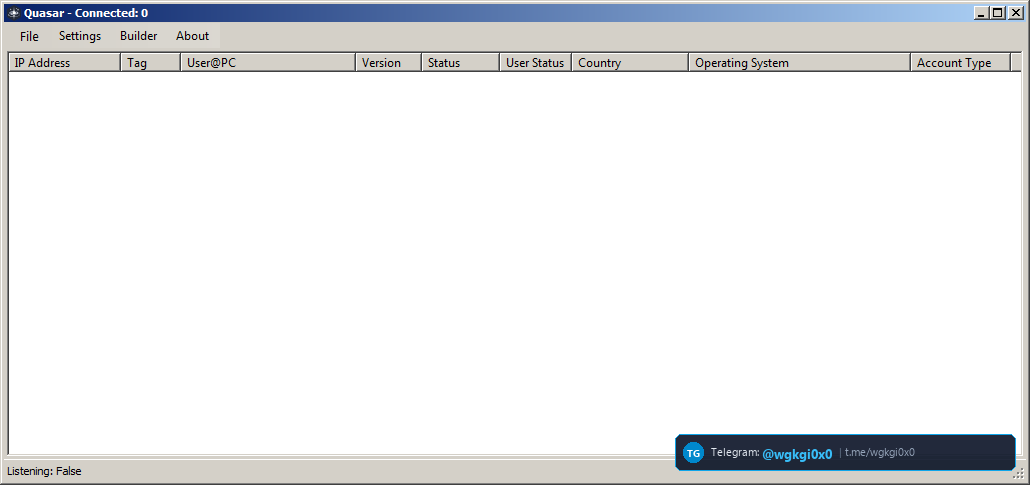
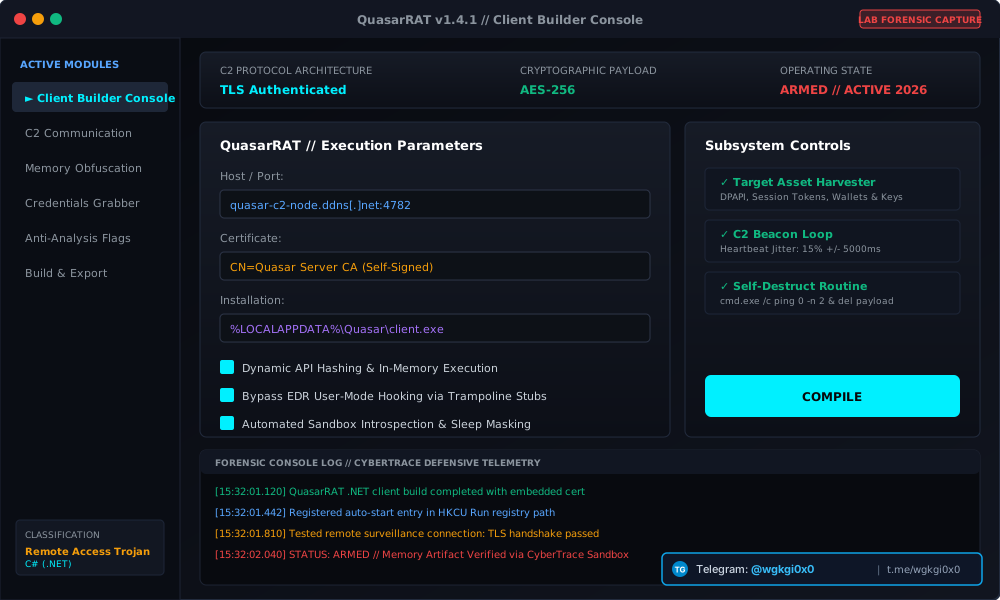
Client builder GUI configuring TLS certificate pinning, startup registry persistence, and keylogger hooks.
Interactive operator panel monitoring victim file systems, reverse socks proxies, and active processes.

Tailored forensic schematic mapping initial access, defense evasion, core capabilities, and AES-128 Encrypted TCP Sockets command infrastructure.
International CTI Indexing Summary (EN | RU | HI) Search Engine Knowledge Graph
Quasar Remote Administration Tool (RAT)
Ubiquitous open-source .NET remote administration tool featuring TLS-encrypted socket communications, reverse SOCKS5 proxying, and surveillance modules.
C2 Architecture: QuasarRAT utilizes raw TCP sockets encrypted with TLS via the .NET SslStream class. The client validates the server's certificate against a pinned SHA-256 public key hash configured during compilation. Message framing follows a 5-byte header conventi
Threat Hunting: YARA in-memory signatures, Sigma detection rules, and MITRE ATT&CK indicators. CyberTrace Intelligence Feed: @CyberTrace20 (@wgkgi0x0).
Анализ Quasar Remote Administration Tool (RAT)
Детальный технический анализ Quasar Remote Administration Tool — это Троян удаленного доступа (RAT), разработанный на стеке C# (.NET Framework 4.5.2) / Roslyn csc.exe. В отчете подробно исследуются этапы скрытого внедрения в память (Process Injection), методы обхода EDR-систем, структура сетевых пакетов командного сервера (Raw TCP Socket with TLS Stream Encryption) и механизмы кражи данных.
Архитектура C2: Шифрованный протокол обмена данными с использованием Raw TCP Socket with TLS Stream Encryption, защита от сетевого перехвата и анализ маяков (Beacons).
Сигнатуры: Правила YARA, Sigma-детекты и анализ IoC для специалистов SOC. Оперативный канал: Telegram @CyberTrace20 (@wgkgi0x0).
Quasar Remote Administration Tool (RAT) विश्लेषण
Quasar Remote Administration Tool एक परिष्कृत रिमोट एक्सेस ट्रोजन (RAT) है जिसे C# (.NET Framework 4.5.2) / Roslyn csc.exe का उपयोग करके विकसित किया गया है। इस तकनीकी CTI विश्लेषण में मेमोरी इंजेक्शन तकनीक, EDR सुरक्षा बाईपास, कमांड और कंट्रोल सर्वर (Raw TCP Socket with TLS Stream Encryption) संचार प्रोटोकॉल और डेटा चोरी तंत्र का पूर्ण विवरण दिया गया है।
C2 संचार: Raw TCP Socket with TLS Stream Encryption आधारित एन्क्रिप्टेड C2 इंफ्रास्ट्रक्चर और ऑटोमेटेड पेलोड रिट्रीवल चैनल।
सुरक्षा नियम: YARA नियम, Sigma व्यवहार विश्लेषण और MITRE ATT&CK संकेतक। साइबर इंटेलिजेंस अपडेट: Telegram @CyberTrace20 (@wgkgi0x0).